

Introduction: Sometimes the Simplest Contamination Control Is Removing the Contact Surface
A cutting tool moves from one plant, sample, batch or material to the next. The edge still looks clean, but visible cleanliness does not prove that sap, tissue, particles, oils, microorganisms, chemical residue or trace material are absent. In some workflows, the cutting surface itself becomes a transfer point.
A replaceable razor blade creates a useful process-control option: instead of repeatedly restoring the same edge to an acceptable condition, the operation can remove that surface at a defined transition. That does not make the workflow contamination-free. It eliminates one possible reservoir.
How a Cutting Blade Becomes a Transfer Point
The pathway is simple: Material A contacts the blade; residue remains on the edge, blade faces, slots, corners or holder interface; the blade then contacts Material B. What “contamination” means depends on the application.
| Industry / Workflow | What May Be Transferred | Why the Blade Matters | Potential Control Strategy |
|---|---|---|---|
| Horticulture / propagation | Sap, debris, bacteria, fungi, viruses, viroids | Tools can mechanically move disease agents plant to plant | Disinfection, dedicated tools or fresh blades at defined transitions |
| Plant tissue culture | Bacteria, fungi, environmental microorganisms, culture material | A contaminated transfer can compromise an aseptic culture | Sterile instruments, aseptic technique, controlled blade changes |
| Medical / precision manufacturing | Particles, fibers, oils, chemicals, lot-to-lot material | The edge may be a product-contact surface | Validated cleaning, dedicated tooling or replacement |
| Laboratory / forensic work | Tissue, DNA, biological residue, trace material | Carryover can compromise sample integrity | Decontamination, disposable tools or dedicated tools |
| Food manufacturing | Allergen or food residue; microorganisms | A tool can carry material between formulations | Cleaning, sanitation, segregation, dedicated or replaceable tools |
Horticulture: Preventing Plant-to-Plant Pathogen Transfer
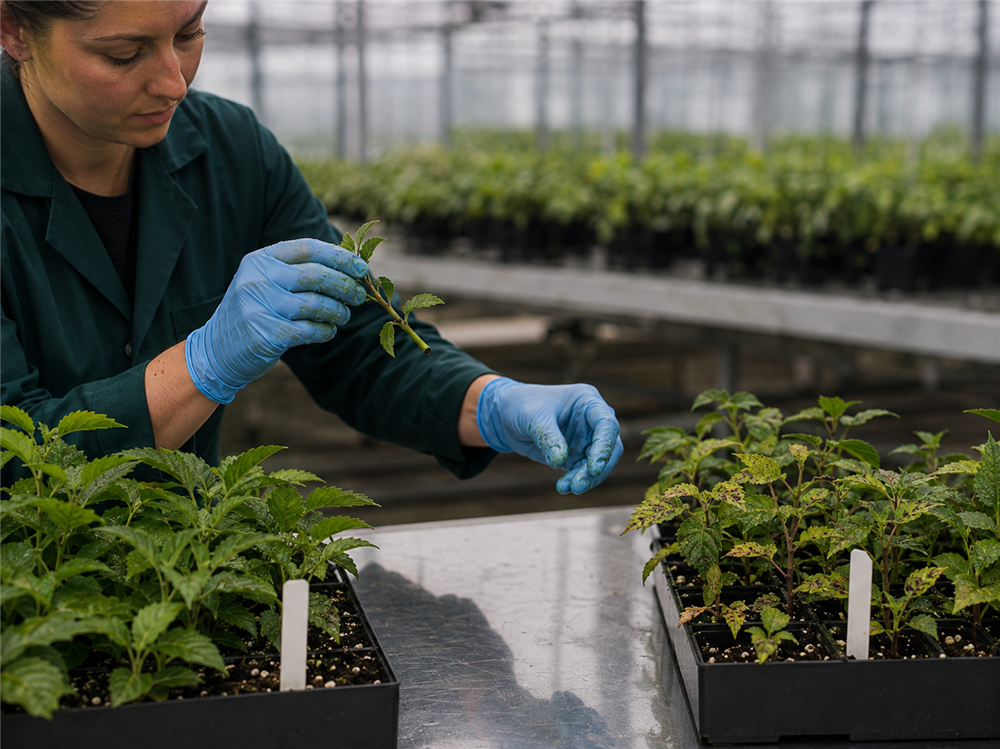
In nurseries, greenhouses and propagation work, cutting tools can mechanically transfer plant disease agents. University extension guidance warns that apparently clean tools may still carry microscopic pathogens, and research has demonstrated mechanical transmission of citrus viroids by knife cuts.
For taking cuttings, grafting, trimming diseased tissue or preparing propagation material, cleaning and disinfection between appropriate plants or plant groups is a standard approach. If the cutting component is inexpensive and replaceable, however, a grower can also ask whether a fresh blade at a defined transition reduces dependence on repeated operator-performed disinfection.
Plant tissue culture raises the standard further. Micropropagation relies on aseptic handling, sterile tools, controlled work areas and prepared explants. UF/IFAS guidance describes sterile scalpels and forceps during transfer and, in one micropropagation protocol, calls for a new scalpel when transitioning to a new Petri dish to avoid potential contamination.
A fresh blade may therefore be attractive when losing a culture costs far more than replacing an edge—but an ordinary packaged blade must never be assumed sterile. Sterility must be supported by documentation.
Medical Manufacturing: Controlling What Travels Between Processes

FDA's Quality Management System Regulation, effective February 2, 2026, incorporates ISO 13485:2016 into the U.S. medical-device quality framework, but it does not create a blanket rule requiring a new razor blade at every batch change. The relevant question is whether the process has identified and controlled its contamination risks.
For a validated trimming or component-preparation process, replacement can sometimes simplify the control logic: instead of repeatedly determining whether a low-cost edge was adequately cleaned, a procedure may specify replacement at a defined changeover. This only works if the replacement blade meets the required material, cleanliness, packaging, corrosion-resistance and process-compatibility criteria.
Cleanroom terminology also matters. ISO 14644-1 classifies air cleanliness by airborne particle concentration; “cleanroom” is not synonymous with “sterile.” ISO guidance separately addresses surface cleanliness and suitability of consumables used in controlled environments.
Laboratories: When Carryover Can Compromise the Result
In laboratory and forensic workflows, contamination may not make the tool unsafe—it may make the result unreliable.
Histology literature identifies tissue carryover as a legitimate contamination problem and describes changing microtome blades among measures used to reduce contaminating tissue fragments. Molecular pathology research has also identified the microtome as a possible source of DNA contamination between paraffin-embedded samples. NIST defines forensic DNA contamination as unintended introduction of exogenous DNA or biological material during collection or testing.
If Tissue A, DNA A or trace material reaches Sample B, the downstream cost can include repeat testing, investigation or questionable interpretation. Depending on the method, laboratories may use decontaminated reusable tools, dedicated instruments or disposable cutting surfaces between specimens.
Food Manufacturing: Cross-Contact Is Different
FDA uses allergen cross-contact for the unintentional incorporation of a food allergen into another food. That is distinct from microbial sanitation. Facilities may use segregation, production sequencing, cleaning, sanitation, dedicated utensils and other preventive controls.
A replaceable blade can support that strategy only where the blade and holder are appropriate for the food-contact process. Disposable does not automatically mean food-safe.Why Disposable Blades Can Make Economic Sense
The comparison is not simply blade price versus reusable-tool price.
Reuse can involve cleaning labor, chemicals, inspection, drying, storage, documentation, validation, downtime and the risk of incomplete cleaning. Replacement adds blade cost, controlled handling, changeover time, sharps management, disposal and any required holder cleaning.
Neither method is universally cheaper. The decision depends on changeover frequency, labor, contamination consequence, cleaning complexity, disposal requirements, volume and blade price.
The important point is that a low-cost cutting component can make removal of the contaminated contact surface economically realistic.
When a Fresh Blade Is Not Enough
Replacing the blade does not clean the holder, gloves, work surface, fixtures, containers, raw material or surrounding equipment. It does not correct poor aseptic technique, airborne contamination, incorrect storage, weak personnel practices or improper production sequencing.
Reusable tools can also be safe and effective when properly cleaned, disinfected, sterilized or otherwise reprocessed according to the applicable procedure. CDC guidance reinforces that cleaning, disinfection and sterilization are distinct processes rather than interchangeable terms.
Selecting Blades for Contamination-Sensitive Work
Selection may involve blade material, coating, thickness, edge geometry, format, packaging, corrosion resistance and holder compatibility. None is a proxy for sterility or cleanroom suitability. “Individually wrapped,” “stainless steel,” “cleanroom ready” “degreased” and “sterile” describe different things.
Frequent blade changes also require controlled safety practices: approved holders, facility-specific change procedures, appropriate PPE and disposal controls. Where blades become contaminated with blood or other potentially infectious material, OSHA's Bloodborne Pathogens Standard treats contaminated sharps as regulated waste requiring appropriate containment.
Conclusion
The value of a disposable blade is not simply that it is inexpensive. In the right process, the entire cutting surface can be removed when it becomes a contamination variable.
Whether replacement is preferable to cleaning, dedication, disinfection or sterilization should follow the actual process risk.
Razor Blade Company supplies blade formats for industrial and professional cutting applications. Contact us to identify options that fit your material, process, cleanliness requirements, holder and purchasing volume; suitability for regulated or controlled use should always be confirmed from the relevant product documentation.
FAQs
Can razor blades spread contamination between materials or samples?
Yes. If residue remains on the cutting edge or blade surface, the tool can potentially transfer that material into the next plant, product, sample or batch it contacts. The actual risk depends on what is being transferred, the process and the consequences of carryover. Replacing the blade removes one possible transfer surface but does not clean the blade holder or surrounding workspace.
Is a disposable razor blade automatically sterile?
No. “Disposable,” “single-use,” “individually wrapped,” “clean” and “sterile” are not equivalent claims. Sterility requires an appropriate sterilization process and supporting product documentation. If a process requires a sterile blade, that status should be confirmed for the specific product rather than inferred from its packaging.
When should a blade be replaced instead of cleaned?
There is no universal change interval. Replacement may make sense when the consequence of transferring residue is significant, changeovers are frequent, reliable reprocessing is labor-intensive, or the cutting component is inexpensive relative to cleaning and verification. Reusable tools remain appropriate where validated cleaning, disinfection or sterilization reliably controls the relevant hazard.
Can single-use blades reduce plant disease transmission?
They can reduce one potential route of plant-to-plant transfer by removing a cutting surface that has contacted the previous plant. This does not replace appropriate sanitation of holders, tools, work surfaces, gloves or propagation equipment, and not every plant or cutting operation requires a new blade after every cut.
What should manufacturers consider when selecting blades for controlled environments?
Consider the contaminant being controlled, blade material, corrosion resistance, coatings, geometry, packaging, holder compatibility, handling procedure, changeover frequency and disposal requirements. If the process requires sterile, cleanroom-compatible, particle-controlled, food-contact or other specialized status, confirm that requirement from specific product documentation rather than assuming suitability from the blade material alone.
Connect With Razor Blade Company
Twitter (X): https://x.com/TheRazorBladeCo
Facebook: https://www.facebook.com/RazorBladeCo
Instagram: https://www.instagram.com/razorbladeco/
Contact Information
Address: 15500 Erwin St Ste 1049, Van Nuys, CA, United States, California
Phone: (310) 452-1034
Email: [email protected]